Introduction
Many businesses are already using AI tools to write emails, summarise reports, or generate content. But using AI is very different from integrating it into the systems that power your business. Research shows that only 11% of Malaysian businesses have deeply embedded AI across their operations, with most still relying on standalone tools for individual productivity.
This is where the difference between Agentic AI vs. Generative AI matters. Both are becoming an integral part of modern ERP and CRM systems, but they serve different purposes. In this guide, we’ll explore what sets them apart, their key features and use cases, and how solutions like Microsoft Dynamics 365 combine both technologies to create smarter, more intelligent business operations.
What is AI?
Artificial Intelligence (AI) refers to computer systems that perform tasks typically requiring human intelligence, such as understanding language, recognising patterns, making decisions, solving problems, and learning from data.
Unlike traditional software that follows predefined rules, AI analyses information, identifies patterns, and uses them to generate content, make predictions, or complete tasks. Today, AI is increasingly embedded into business applications to help organisations automate processes, improve decision-making, and boost productivity.
What is Agentic AI?
Agentic AI is a type of artificial intelligence designed to plan, make decisions, and complete tasks autonomously to achieve a specific goal. Unlike Generative AI, which creates content in response to prompts, Agentic AI is built to take action without constant human guidance, while still relying on people to set objectives and oversee outcomes.
Instead of waiting for users to provide instructions at every step, Agentic AI can understand an objective, determine the actions required, interact with different applications, and adapt its approach as new information or changing conditions arise.
For example, rather than simply generating a purchase order, an Agentic AI system could monitor inventory levels, detect when stock is running low, compare supplier pricing, create the purchase order, submit it for approval, and notify the purchasing team, all within a single workflow. This ability to execute multi-step processes makes Agentic AI particularly valuable for automating complex business operations.
How Does Agentic AI Work?
Unlike traditional AI assistants that respond to one request at a time, Agentic AI works towards achieving a defined objective. Once given a goal, it can break the task into smaller steps, decide what actions to take, interact with different software systems, and adjust its actions based on the results.
A typical Agentic AI workflow looks like this:
- Understands the objective by interpreting the user’s request or business goal.
- Creates a plan by breaking the objective into smaller, manageable tasks.
- Takes action by interacting with connected business applications, databases, APIs, or external tools.
- Monitors progress by evaluating whether each task has been completed successfully.
- Adapts when necessary by responding to errors, changing conditions, or new information until the objective is achieved.
Instead of simply suggesting the next step, Agentic AI actively carries out the workflow on behalf of the business. This is why agentic AI is called proactive.
Key Features of Agentic AI
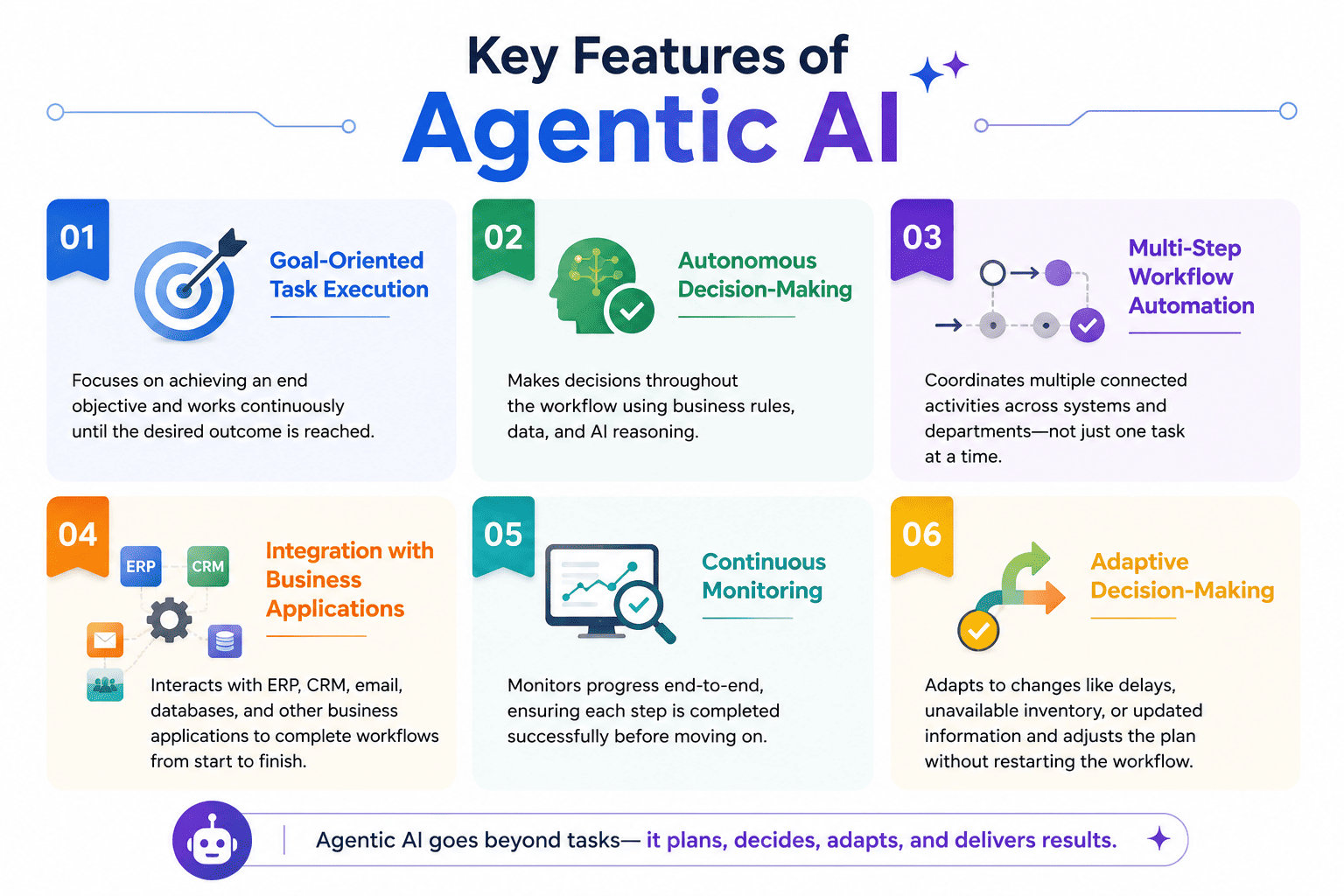
1. Goal-Oriented Task Execution
Agentic AI focuses on achieving an end objective rather than responding to individual prompts. It continuously works towards completing the assigned task until it reaches the desired outcome.
2. Autonomous Decision-Making
Using predefined business rules, available data, and AI reasoning, Agentic AI can make decisions throughout a workflow without requiring constant human input.
3. Multi-Step Workflow Automation
Unlike conventional automation tools that perform one task at a time, Agentic AI can coordinate multiple connected activities across different systems and departments.
4. Integration with Business Applications
Agentic AI can interact with ERP systems, CRM platforms, email applications, databases, collaboration tools, and other business software to complete workflows from start to finish.
5. Continuous Monitoring
Rather than stopping after one action, Agentic AI monitors progress throughout the process, ensuring each step is completed successfully before moving on.
6. Adaptive Decision-Making
If circumstances change, such as delayed shipments, unavailable inventory, or updated customer information, Agentic AI can adjust its plan without restarting the entire workflow.
Common Use Cases of Agentic AI
As organisations look to automate more than just repetitive tasks, Agentic AI is becoming increasingly valuable across finance, operations, customer service, and supply chain management.
Some common applications include:
1. Inventory Management
Agentic AI continuously monitors inventory levels, predicts future demand, identifies shortages, and automatically initiates replenishment workflows when stock reaches predefined thresholds.
2. Supply Chain Management
Agentic AI can monitor supplier performance, track shipments, identify potential delays, and recommend alternative suppliers or logistics routes before disruptions affect operations.
3. Customer Service
Agentic AI can analyse incoming enquiries, prioritise urgent cases, assign tickets to the appropriate teams, recommend solutions, and follow up with customers automatically.
4. Sales and CRM
By analysing customer behaviour and sales opportunities, Agentic AI can prioritise leads, recommend next actions, schedule follow-up activities, and help sales teams focus on high-value opportunities.
5. Financial Operations
Finance teams can use Agentic AI to automate invoice processing, detect unusual transactions, reconcile accounts, monitor cash flow, and prepare financial reports for review.
6. Human Resources
Agentic AI can automate onboarding tasks, schedule interviews, monitor training progress, answer employee questions, and assist with workforce planning.
7. Software Development
Agentic AI can help manage software development from start to finish by planning tasks, writing code, testing for errors, and fixing issues automatically.
Pros and Cons of Agentic AI
Pros
- Automates complex workflows: Can execute multi-step business processes across ERP, CRM, and other systems without requiring employees to manage each step manually.
- Reduces repetitive manual work: Handles routine operational tasks such as purchase orders, approvals, lead routing, and workflow coordination, allowing employees to focus on higher-value work.
- Faster decision-making: Monitors business data in real time and takes action based on predefined rules, reducing delays caused by manual reviews.
- Improves operational efficiency: Coordinates activities across departments, helping finance, procurement, sales, and operations work together more seamlessly.
- Adaptive improvement: Refines its decisions and workflows through feedback loops, becoming more effective over time.
- Smarter resource planning: Allocates people, budgets, inventory, and other resources based on business priorities and real-time conditions.
- Supports 24/7 operations: Continuously monitors business processes and responds to events outside normal working hours, helping maintain business continuity.
Cons
- Requires strong governance: Autonomous actions need clearly defined business rules, approval workflows, and human oversight to prevent unintended outcomes.
- Complex implementation: Deploying Agentic AI often requires integration across multiple business systems, making implementation more challenging than standalone AI tools.
- Dependent on data quality: Poor, incomplete, or outdated business data can lead to incorrect decisions or inefficient workflows.
- Security and compliance concerns: Giving AI access to critical business systems increases the importance of robust access controls, auditing, and regulatory compliance.
- Lower transparency: Some AI-driven decisions can be difficult to explain, making it harder for businesses to understand why certain actions were taken.
- Higher implementation costs: Businesses may need to invest in system integration, process redesign, employee training, and ongoing monitoring before seeing the full benefits.
- Integration challenges: Deploying Agentic AI often requires connecting it with multiple business applications, which can take time and planning.
What is Generative AI?

Generative AI is a type of AI that creates original content in response to a user’s prompt or request. Generative AI generates new outputs by identifying patterns learned from vast amounts of training data. It responds specifically to your instructions and requests, but does not take action on its own.
Depending on the model, Generative AI can generate:
- Text, such as articles, emails, and reports
- Images and graphics
- Computer code
- Marketing and product content
- Audio and video
One of its most valuable capabilities is summarisation. Rather than simply shortening text, Generative AI analyses the source material and creates a new, concise version that captures the key ideas. This may involve rewriting the content in its own words (abstractive summarisation) or identifying and compiling the most important sections (extractive summarisation).
Most people interact with Generative AI through conversational assistants like ChatGPT and Microsoft Copilot. For businesses, it helps employees create content, summarise information, and complete writing, research, and documentation tasks more efficiently, improving productivity across everyday workflows.
How Does Generative AI Work?
Generative AI works by learning patterns from large amounts of data and using those patterns to generate new content. It is often described as reactive AI because it responds to a user’s prompt rather than acting independently or making decisions on its own.
Here’s how the process works:
- Training the model: Generative AI is trained on vast amounts of text, images, code, audio, and other data. During training, it learns patterns, relationships, and context instead of memorising information.
- Understanding the prompt: When a user enters a prompt, the AI breaks it into smaller units called tokens, which may represent words, parts of words, or characters. It analyses these tokens together with the surrounding context to understand the user’s request.
- Generating a response: The model predicts the most appropriate sequence of words or content based on what it has learned, producing a coherent and natural-sounding response.
- Improving output quality: The quality of the response depends on factors such as the model’s training, the clarity of the prompt, and the amount of context provided. More specific prompts generally produce more accurate results.
Key Features of Generative AI
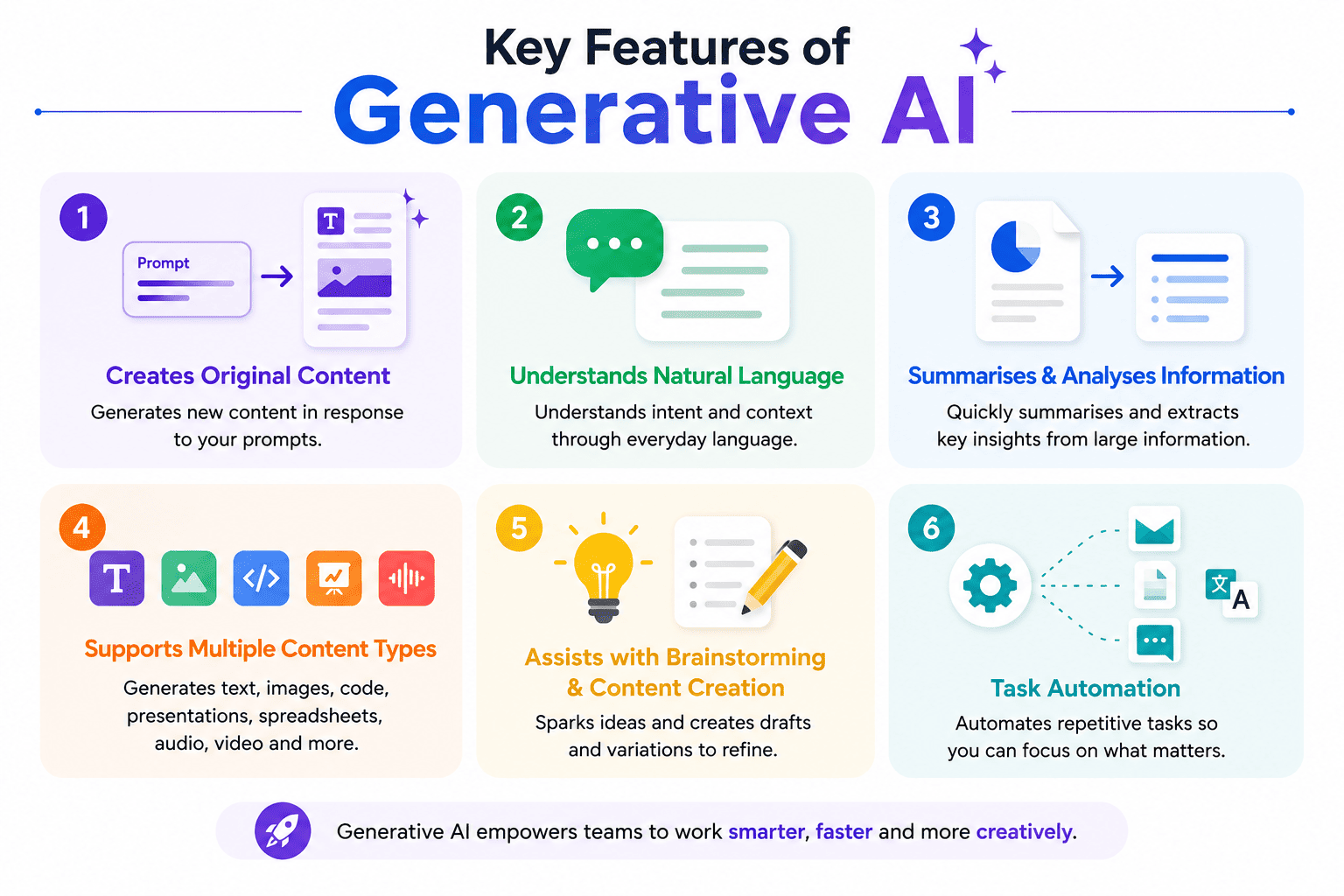
1. Creates Original Content
Unlike traditional automation tools, Generative AI produces new content in response to user prompts, generating articles, reports, emails, marketing copy, product descriptions, and more, but only when instructed to do so.
2. Understands Natural Language
One of Generative AI’s core capabilities is understanding and interpreting natural language. Instead of relying on predefined commands or programming syntax, it can process conversational prompts, recognise context and intent, and generate relevant responses in everyday language.
3. Summarises and Analyses Information
Businesses often work with large volumes of documents and data. Generative AI can quickly summarise lengthy reports, meeting notes, research papers, customer interactions, and financial documents, helping employees find important information faster.
4. Supports Multiple Content Types
Modern Generative AI models can generate various forms of content, including text, images, code, presentations, spreadsheets, and even audio or video, depending on the platform being used.
5. Assists with Brainstorming and Content Creation
Generative AI can help employees overcome creative blocks by suggesting ideas, drafting outlines, generating marketing campaigns, or producing multiple content variations for user refinement.
6. Task Automation
Generative AI helps streamline repetitive knowledge-based tasks such as drafting emails, generating reports, summarising documents, translating content, and answering questions, allowing employees to work more efficiently.
Common Use Cases of Generative AI

Generative AI has moved from a novelty to a practical tool across nearly every business function. Here are some of the most common ways organisations are putting it to work:
- Content Creation and Marketing
- Customer Service and Support
- Document Summarisation and Reporting
- Sales Enablement
- Software Development
- HR and Recruitment
- Research and Data Analysis
Pros and Cons of Generative AI
Pros
- Faster content production: Gen AI drafts marketing copy, reports, and internal communications in seconds, cutting down the hours teams spend on repetitive writing tasks
- Lower operational costs: Reduces the manual labour needed for routine work like summarisation, first-draft writing, and basic customer service queries, freeing up budget for higher-value hires
- Round-the-clock customer support: Chatbots and virtual assistants can handle customer queries at any hour, improving response times without expanding headcount
- Scales with demand: Can generate hundreds of product descriptions or handle thousands of customer queries at once, without the bottlenecks of manual work
- Personalisation at scale: Tailors emails, product recommendations, and marketing content to individual customers based on their data, something that would take significant manual effort otherwise
- Faster onboarding and training: Helps teams produce training materials, SOPs, and internal documentation more quickly, keeping resources current as processes change
- Lower skill barrier: Allows non-specialist staff to produce usable first drafts of code, copy, or designs, reducing dependency on specialist teams for routine requests
- Competitive responsiveness: Helps smaller teams keep pace with larger competitors by automating content and communication work that would otherwise require more staff
Cons
- Accuracy issues (hallucinations): Can produce information that sounds convincing but is factually wrong, which is a real risk if outputs are used in reports, client communications, or compliance documents without review
- Data privacy and security risks: Feeding sensitive company or customer data into public AI tools can expose a business to data leaks or compliance breaches, particularly in regulated industries
- Bias in outputs: If the training data contains biases, the AI can reproduce them in customer-facing content or decision-support material, creating reputational or legal risk
- Copyright and IP uncertainty: Since outputs are generated from patterns in existing data, questions remain around ownership of AI-generated content, an important consideration for published or branded material
- Inconsistent output quality: Results depend heavily on prompt clarity and the model used, meaning a business may get genuinely useful output one day and unusable content the next
- Over-reliance risk: Teams that lean too heavily on AI-generated content may see a decline in original thinking, writing quality, or institutional knowledge over time
- Implementation and training costs: While the tools themselves may be affordable, integrating them properly, training staff, and building review processes still require time and investment
Quick Comparison: Agentic AI vs Generative AI
Feature | Generative AI | Agentic AI |
|---|---|---|
Primary purpose | Creates new content | Completes tasks and achieves goals |
Main output | Text, images, code, reports | Completed workflows and business actions |
Decision-making | Limited to generating responses | Makes decisions throughout a process |
Human involvement | Prompt-driven with frequent user input | Minimal human intervention after goals are defined |
Task execution | Usually completes one request at a time | Handles complex, multi-step workflows |
Software integrations | Can connect to business applications for context | Actively interacts with multiple systems to complete tasks |
Best suited for | Writing, summarising, analysing, brainstorming | Process automation, operational efficiency, and decision-making |
Business examples | Drafting emails, generating reports, and summarising meetings | Managing inventory, routing customer cases, and automating procurement |
Neither technology replaces the other. Instead, they complement one another by combining intelligent content generation with autonomous task execution.
For example, a sales representative using Microsoft Dynamics 365 could ask Generative AI to summarise a customer’s purchase history before a meeting. After the meeting, Agentic AI could automatically create follow-up tasks, schedule reminders, update the CRM record, notify the sales manager, and trigger the next stage of the sales workflow without requiring constant manual intervention.
Emerging Trends in Agentic AI and Generative AI

Artificial intelligence continues to evolve rapidly, with businesses moving beyond using AI as a productivity tool towards making it an active part of daily operations.
Some of the biggest trends include:
- AI agents in business applications: ERP, CRM, and other enterprise platforms are increasingly embedding AI agents that can automate workflows and reduce repetitive manual tasks.
- Multi-agent collaboration: Multiple specialised AI agents work together across different business functions, such as inventory, procurement, finance, and customer service, to complete complex workflows.
- Human-in-the-loop governance: AI handles routine tasks while employees review or approve high-impact decisions, helping businesses balance automation with oversight.
- More autonomous business processes: AI is progressing from simply generating responses to identifying issues, recommending actions, and carrying out workflows with minimal human intervention.
- Stronger AI governance and security: Organisations are placing greater emphasis on data privacy, regulatory compliance, transparency, and responsible AI to ensure secure and ethical use.
- Industry-specific AI agents: AI solutions are becoming more tailored to industries such as manufacturing, retail, healthcare, finance, and professional services, enabling more relevant automation.
The Role of Agentic AI & Generative AI in ERP & CRM
Businesses do not need to choose between Agentic AI and Generative AI. While Generative AI creates content and analyses information, Agentic AI executes tasks and automates workflows. Together, they improve productivity, reduce manual work, and support better decision-making across ERP and CRM systems.
Before exploring their use cases, let’s briefly look at what ERP and CRM are.
What Are ERP and CRM?
Enterprise Resource Planning (ERP) software helps businesses manage core operations such as finance, accounting, inventory, procurement, manufacturing, and supply chain activities from a single system. Learn more in our What Is ERP? guide.
Customer Relationship Management (CRM) software helps businesses manage customer interactions across sales, marketing, and customer service, making it easier to build relationships and improve the customer experience.
Together, ERP and CRM provide the business data and workflows that Generative AI and Agentic AI use to assist employees, automate processes, and support better decision-making.
How is Generative AI Used in ERP and CRM?
Within ERP and CRM systems, Generative AI acts as an intelligent assistant that helps employees work more efficiently. Rather than searching through multiple screens or manually compiling information, users can simply ask questions in natural language and receive relevant answers or generated content.
In ERP
- Generating reports and forecasts: Analyzes historical business data to create financial, sales, inventory, or demand forecasting reports that support planning and decision-making.
- Supporting invoice processing: Extracts key information from invoices, summarises documents, and assists with matching invoices to purchase orders before human review.
- Supporting HR processes: Drafts job descriptions, onboarding documents, training materials, performance reviews, and internal HR communications.
- Anomaly detection: Analyses business data to identify unusual transactions, spending patterns, or performance metrics, then generates summaries and insights to help teams investigate potential issues more quickly.
- Order and supply chain management: AI analyzes inventory, orders, and supply chain data to generate demand forecasts, identify potential bottlenecks, and provide recommendations for improving fulfilment and inventory planning.
In CRM
- Drafting customer emails and follow-up messages: Creates personalised emails based on customer enquiries, previous interactions, or sales opportunities.
- Summarising customer interactions and sales opportunities: Condenses call notes, emails, and CRM records into concise summaries for sales and customer service teams.
- Enhancing customer support: Generates suggested responses, summarises support cases, answers common customer enquiries through AI chatbots, and assists support agents with faster resolutions.
How is Agentic AI Used in ERP and CRM?
Agentic AI goes beyond assisting employees by actively carrying out business processes. It can monitor events across connected systems, make decisions based on predefined rules and business objectives, and execute tasks with minimal human intervention.
In ERP
- Automated procurement: Creates purchase orders automatically when inventory reaches predefined thresholds.
- Invoice approval workflows: Routes invoices and purchase requests through the appropriate approval process based on business rules.
- Supplier management: Monitors supplier performance and identifies potential disruptions before they impact operations.
- Business KPI monitoring: Tracks operational and financial KPIs, recommending or triggering corrective actions when issues arise.
- Cross-functional workflow automation: Coordinates processes across finance, procurement, inventory, and operations to complete multi-step workflows.
In CRM
- Lead assignment: Distributes new sales leads based on territory, availability, expertise, or customer value.
- Customer support routing: Automatically assigns support cases to the most appropriate team or agent for faster resolution.
- Multi-channel follow-ups: Coordinates timely follow-up emails, calls, and messages based on customer activity and engagement.
- Adaptive proposals and pricing: Recommends or updates proposals and pricing based on customer needs, sales history, or changing business conditions.
- Proactive issue resolution: Detects potential customer service issues early and initiates the appropriate workflow before they escalate.
Conclusion
Generative AI and Agentic AI work best as a team, not as competitors. Generative AI helps your people create content, analyse information, and work more efficiently, while Agentic AI takes action by automating workflows and supporting key business decisions. Together, they’re reshaping what ERP and CRM systems can do, helping businesses work smarter, faster, and more efficiently.
As a certified Microsoft Dynamics 365 Business Central Partner, we help businesses implement and optimise Microsoft Dynamics 365 with the latest Generative AI and Agentic AI capabilities. From AI-powered Copilot to intelligent workflow automation, we’ll help you get the most out of your ERP and CRM system. Contact us today to learn how Microsoft Dynamics 365 can help your business work smarter and automate with confidence.
Frequently Asked Questions
1. What is the difference between Agentic AI and Generative AI?
Generative AI creates original content, such as text, images, reports, or code, based on user prompts. Agentic AI focuses on achieving goals by planning, making decisions, and completing tasks autonomously.
2. Can Agentic AI use Generative AI?
Yes. Agentic AI often uses Generative AI to create emails, reports, summaries, or recommendations while independently carrying out the actions needed to complete a business process.
3. Which is better for businesses?
Neither is inherently better. Generative AI is ideal for content creation and productivity, while Agentic AI is better suited for automating workflows and operational processes. Many businesses benefit most from using both together.
4. Is Microsoft Copilot Agentic AI or Generative AI?
Microsoft Copilot primarily uses Generative AI to help users create content, analyse data, and answer questions. Microsoft is also introducing AI agents within Dynamics 365 that add Agentic AI capabilities by autonomously completing business tasks.
5. Which industries benefit the most from Agentic AI?
Industries with complex workflows, such as manufacturing, retail, finance, healthcare, logistics, and professional services, can benefit significantly from Agentic AI by improving efficiency and reducing manual processes.
6. Is Agentic AI more expensive than Generative AI?
Costs vary depending on the platform, implementation, and level of automation required. Agentic AI solutions may involve higher implementation costs because they integrate deeply with business systems and automate end-to-end workflows.
7. What is the difference between Agentic AI and AI Agents?
Agentic AI is the broader technology that enables AI to plan, make decisions, and solve problems autonomously. AI agents are individual software tools designed to perform a single task or a specific workflow, such as answering customer enquiries or routing support tickets.